
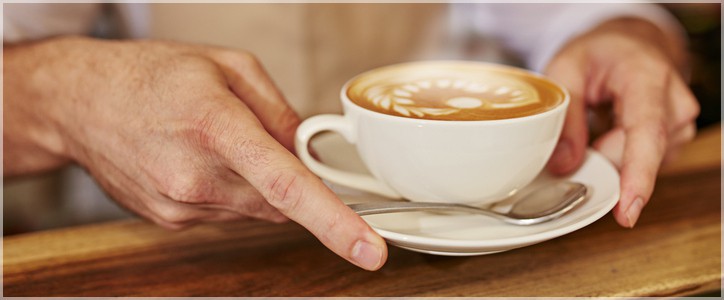
A latte is more correctly known as a "Cafe Latte", though most large-scale commercial chains will make a cafe latte by default when you ask for a latte. The exception to this will be true Italian or other European restaurants, where ordering a "latte" will literally get you just a glass of steamed milk.
The milk used for the Caffe Latte is steamed and frothed to create a creamy, velvety texture that blends well with the intensely concentrated and flavorful espresso creating a harmony of flavors. The frothing of the milk is done using the steam wand of the espresso machine.
A cafe latte consists of 2 fluid ounces of espresso, 3 ounces of steamed milk, and typically a thin layer of foam on top. It can sometimes be referred to as a "Wet Cappuccino".
For instructions, see How to make a Latte.
Latte vs. Cappuccino vs. Macchiato
This differs from a cappuccino which is equal parts espresso and steamed milk and foam, while an Espresso Macchiato which is equal parts espresso and foamed milk, without the steamed milk. Macchiatos are sometimes called "Dry Cappuccinos".
Most commercial coffee shops have turned a Cappuccino into a Macchiato (eg. they leave out the steamed milk portion), and use the "Macchiato" term for flavored drinks.
Espresso Field Guide by OrbitVisual.com
Other "Lattes"
While the most common Latte is a Caffe Latte, it can be made using something else as a substitute for the espresso. Common alternatives include mate ("maw-teh"), chai or matcha.
There are also a number of alternatives to milk on the market for those that are lactose intolerant or have other dietary needs. Companies such as Pacific Barista have specially formulated almond milk, soy milk and coconut milk alternatives, as well as some more niche ones like rice milk and hemp milk. While normal off-the-shelf products at a grocery store can be used, barista-specific brands have micro-foaming agents and other foaming agents that make it easier to froth and steam.
There are also "specialty" lattes, such as the activated charcoal latte.
Simple Steps Guarantee Creamy, Velvety Milk and Smooth, High-Quality Foam
When you steam milk for a latte and other espresso drinks, you are injecting air into the milk to create a creamy and velvety milk with a very rich taste. The skilled barista creates a smooth foam without large bubbles so it blends with the espresso drink in a harmony of flavors.
Tips for Perfect Steamed Milk and Foam
- Use very cold milk. Take it out of the refrigerator just before you use it and then fill your steaming pitcher about one third full. Do not fill it any fuller because when you steam and aerate the milk properly it will double or even triple in volume.
- A good choice of milk is either one percent or two percent milk as this will create better foam than whole milk and a better flavor than low fat milk. While the volume of the milk won't increase is much when you use a milk with more fat, the taste and texture will be richer.
- Before you begin steaming/aerating the milk purge the steam wand to get rid of any water that may be inside. Do this by putting a damp towel over the top of the steam wand and then turn on the steam for a few moments.
The Art of Steaming a Latte
- Now place the steam wand into the milk in the steaming pitcher and turn on the steam as you aim the steam wand slightly off center so the milk starts to flow in a circular motion.
- Keep the steam wand submerged because if you let the tip of the wand come above the surface of the milk it will create large, undesirable bubbles and will also cause splattering
- Make sure that the tip of the steam wand stays just beneath the surface of the milk and also that the vortex maintains its circulatory movement.
- Listen carefully to the sound the process makes - it should sound like something frying on a grill. When you achieve this sound you know you have for the optimal location for the steam wand to inject air into the milk.
- When you find the right location to hold the steam wand in the milk then you should not have to move the steaming pitcher at all because the angle of the pitcher and the pressure coming from the steam wand will maintain the milk's circular motion. The only movement required will be to slowly lower the steaming pitcher as the volume of the milk expands.
- With the tip of the steam wand just beneath the surface and the milk rapidly flowing in a circular motion, any large bubbles that form on the surface of the milk should quickly roll back into the milk. Only very small bubbles will remain.
Finding the "Sweet Spot"
Getting your pitcher at the right angle is critical to creating steamed milk - too many bubbles/foam and you'll end up with a cappuccino instead of a latte. Fine tune your steaming skills by paying attention to:
- The location of the steam wand that causes a layer of foam to begin forming atop the milk but without creating any large bubbles is known as the "sweet spot."
- Once you have found the sweet spot, with the steam wand just kissing the milk's surface and the foam beginning to form, the milk's rolling action should continue and very small and silky bubbles should be create the foam.
- Gauge how much foam you will need based upon what type of espresso drink you are preparing. For example, if you are making a cappuccino you will need a fair amount of foam so allow the steam wand to stay near the surface a bit longer than for a latte.
Common Mistakes During Steaming a Latte
Making a latte is a skill best learned through repetition and purposeful practice - each drink is an opportunity to learn something new and correct past mistakes in search of that perfect latte. Here's a few things to avoid:
- Keep an eye on the quality of the foam and if there are too many large bubbles and too little foam then submerge the steam wand just a bit deeper so more steam pressure is created. Again listen for the high-pitched hissing sound as you continue the aeration process.
- Check the temperature of the milk during the steaming and aerating process. Once the temperature reaches about 145 degrees Fahrenheit halt the steaming to avoid overheating and scalding the milk. This will cause a off-taste that will taint your espresso drink.
- If there happens to be a few large bubbles atop the pitcher then you might want to lightly tap the bottom of the steaming pitcher on the counter several times and it will diminish the bubbles.
- Once you have finished steaming and aerating the milk, clean off the steaming wand using a moist towel. Also turn on the steam for a moment while the towel is placed over the tip of the steaming wand. This will get rid of any milk that remains in or on the tip.
History of the Caffe Latte
As early as 1847 the English term Caffe Latto was used and then the essay Italian Journeys by William Dean Howells in 1867 who used the term caffe latte.
Respected coffee author and reviewer Kenneth Davids has written that the Caffe Latte is basically an American invention and even in Italy it was first found in Italy only in places with predominantly American tourists.
Some say the Caffe Latte was developed for Americans because the traditional Cappuccino was too strong so more steamed milk was added.
A Caffe Latte in the Italian Tradition
The traditional Italian Caffe Latte is usually made in the person's residence using a stovetop Moka Pot (Stovetop espresso maker). Unlike the American version, the milk is not steamed and frothed, but only heated. The hot milk is placed in a cup and the then the concentrated coffee from the Moka pot is poured into the milk.
Barista Espresso Drink Tips - Brew the Perfect Latte
Flavored Caffe Lattes
While the term Caffe Latte simply means "Coffee with Milk," and is usually made with coffee and steamed milk, many people like to add sweet syrups in a variety of flavors. Some popular Caffe Latte flavors include vanilla, caramel and chocolate.
A few teaspoons of the flavored syrup are added to the espresso and stirred in, and then the steamed milk is added. These flavored syrups can be purchased so home baristas can also enjoy flavored lattes.
What is Latte Art?
Latte art has become increasingly common in coffee shops of Europe and America where Baristas add a flourish to the specialty coffee drinks by creating a bit of art atop the steamed and aerated milk to add some aesthetic appeal.
Various shapes and patterns are drawn by the way the steamed milk and foam is poured into the beverage including such designs as trees, hearts and flowers. While this can be done by hand by experienced baristas (and can be fun to try yourself at home), a much simpler solution for amateurs is to use a stencil combined with some sort of cinnamon or chocolate topping.
Espresso and Coffee Brewing Tips
For instructions on making the very best espresso drinks see Espresso Drink Recipes and the How to make a Latte. Also provided are tips on Pulling A Perfect Espresso Shot.
For the history of espresso and coffee see World's Best History of Coffee, and for a complete list of coffee terminology with detailed definitions see the Espresso Coffee Guides Coffee Terms.
Leave a Reply